Return on time

The choices we make about how we spend our time don’t just speak to what we value, but often more about the habits and routines we’ve developed. Time is scarcest of resources and yet we often waste it on frivolous things. Can we calculate return on time so we understand the tradeoffs? Our actions are based on three primary motivations

  • We are obligated to – if we don’t we get in trouble – Fear of repercussion
  • We like to – this is intrinsic motivation in the activity – Joy of activity
  • We don’t think – these are automatic motions – things we do without much thought – Habit and formation

The last category is the most wasteful, but likely eats up many hours in our day – flipping on the television, surfing the web (I just procrastinated for 40 minutes writing this post on irrelevant content), looking through unimportant emails amongst others etc.

So what would we measure? Below is how I would think about return on time.

  • Impact / Outcomes:
    • Pleasure
    • Financial gain
    • Recognition
    • Building relationships
    • Improving our health
  • Effort / Energy
    • Physical
    • Financial
    • Mental
  • Time Value
    • The value we place on the time

I’d visualize it something like this:
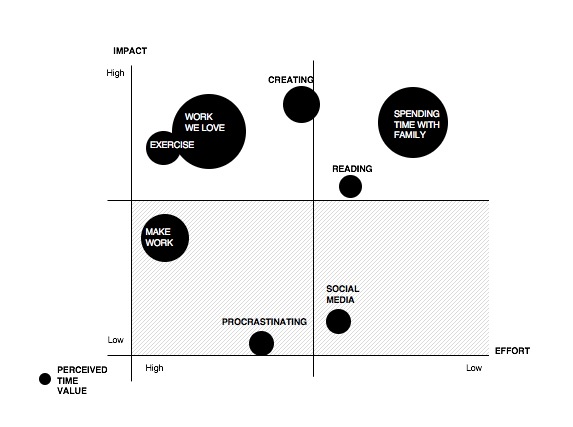
Return on Time

It’s an interesting exercise to go through to plot how we spend our time. If we approached all of our actions with this kind of evaluation, I wonder how it would change our decisions. What would your matrix look like?

Flip the switch

I’ve been obsessed this summer with the idea of flips. A flip is the moment when the intent and context of something changes to have the opposite impact.

The idea first started with the new red dice in the game of Monopoly. They call it the speed dice which helps move what could be a many hours game along. The premise is you can roll the dice and it gives you a series of move options. If you roll Mr. Monopoly, you get to move the number spaces rolled on the other two die AND THEN move to the next available property. Once all the properties are purchased, rolling Mr. Monopoly then sends you to the first property NOT owned by you so you have to pay rent.

This rule is actually quite a startling metaphor for many things in our lives. For the entire first part of the game, you want to role Mr. Monopoly to accumulate more properties. Then, somewhere along the game, once all the properties are gone, it’s value completely changes from creation to destruction. You now need to pay on the property you land on that’s not yours.

There are so many analogous situations in life.

  • Spend your entire life saving and contributing to a retirement savings plan, but once you hit a certain age or if you have to start taking it out, you get hit with tax bills if you didn’t understand there were penalties for saving so much.
  • Start Ups are another great example. Operating models that work when they’re small, will hurt them when they grow. Changing the ways in which work is done and valued is critical.
  • ….

There are many other examples of flips. More to come on this topic.

Building and momentum

Yesterday I wrote about the behaviour behind streaks. Today, a similar topic on momentum and positive fly wheels. I’ve been working over the past 9 months on a new initiative. One which requires alignment of many many … did I say many … stakeholders. Over this time, it’s been a roller coaster of highs ( we’re getting somewhere! ) and lows ( we’re just talking in circles without direction ). In the last two weeks alone, there have been multiple cycles and loops.

This week though, something has changed. The energy has shifted and the air smells different. The initiative has carved out a foothold. The right instigations, right time, right place, right context – everyone has gotten on the train.

That’s the power of momentum when building something. You need the small wins to fuel the big wins (we’re not there yet) grounded in the grind. There is so much in the foundational set up for success. We need to align people, align problems, align intentions … and all of that alignment takes time.

I didn’t truly understand the time it takes until literally this moment. But once the ball gets rolling it gathers momentum and continues down it’s path. This is the double edged momentum sword. If it’s not going down the right hill,  the sheer energy it takes to bring it back can be crippling. Once you get it going on the right path – that’s when the magic happens. So what is your the rolling rock you will use build the next game changing product or service.

Identity wrappers

This morning I had a virtual coffee meeting with a bold, “say it like it is” entrepreneur and speaker – let’s call her K – who I’m lucky to call a friend for the past 15 years. Among the things we talked about – the pendulum between insignificance and ego, an ethnography of corporate culture and the reality of just trying hold life together with tape and string.

Reflecting on our conversation – I couldn’t help but think that our approach to the world is through how we wrap our identity – what skin we’re wearing. These skins both protect us and guide our intentions and behaviour. Who am I as a corporate exec – as a leader – as a designer – as an entrepreneur – as a parent. When we surround our identity in these casings and then reflect on how we’re doing in them, it can elevate and us into ego or cast self doubt. Add to that, the fluid and rapid way in which these skins can change daily – and even hourly.

It can be both exhilarating and debilitating.
It can both define and be defined by.
You can both find and lose yourself.

Both. At the same time.

Energy ebb & flow

There is no doubt you have a million things on your plate. With the demands of work and personal life – how you manage energy will make or break you – literally. Speaking from experience (and still trying to figure it out every day), energy drives outcomes, whether desired or undesired. Managing the ebb and flow of energy in high performance, high pressure environments is incredibly difficult – but for those who have found it, all the power to them. To help manage my energy, I think about this idea:

If the house isn’t on fire, don’t worry about it
If the house is on fire and you do your job, it will go out
If the house is on fire, you do your job and it didn’t go out, it wouldn’t have anyway

Put your energy where it will matter. Avoid putting out fires that aren’t there or dwelling on fires that couldn’t be stopped after 100% effort.

When ego gets in the way

Today I encountered two instances of ego getting in the way good decisions – one personal and one professional.

For the personal project, I designed a house, engaging a well known and reputable architect. We did all the right things, consultations with the city, discussions with neighbours, thoughtful design. When we submitted to the city, despite support from city staff, neighbours and current planners, one voice in the room (the city’s ex-planner who’s outsized ego and outdated point of view is well known) – chose to oppose it, swaying the group to deny the application. I appealed. This was 4 months ago. Today was the appeal hearing. Typically taking days or weeks with witnesses, expensive lawyers and experts, the tribunal chair took 39 minutes to declare in favour of the project.
One ego caused hours of wasted effort and months of wasted time.

At work, a similar story emerged. Strong personality + ego + impatience + stress = an explosive combination. Cultures build in an environment of openness, not when there are directives and an unwillingness to question. Respectful opposition is seen as undermining when it should be additive. Building a high performing organization is not a straight line but iterates and pivots over time. Ego gets in the way by driving towards the bullet answer. The danger with ego at work is that there are too many other factors – concern for financial security, career and reputation impact.
Ego can throw meaningful work and culture into disarray. 

From my experience, some hallmark signs of ego include:

  1. Unable to let go of a firm belief even when faced with clear evidence to the contrary
  2. The inability to see issues from different perspectives
  3. A lack of listening and a focus on talking “at you”
  4. In the extreme – delusional reality and distorted memory
  5. The clear need to be right (even when no one else cares)

What are signs you’ve seen?

Resiliency and pain

From start to finish, pain bears resiliency. The trick is staying strong mentally, emotionally, spiritually and physically when things are difficult, ambiguous and there isn’t a clear path. With each experience, muscles form that give the ability to face future challenges. Like rings in a tree trunk, layers of dirt to hard earth, we are the unique product of our hard won experiences.

Perspective is reality

Perspective is highly personal. It’s how you see the world, live in it, react to it. Our perspectives are coloured by our experiences which are coloured by our perceptive … So our realities are not anyone else’s. Let that sit for a minute. We interact across space and time with others yet everything we experience is fundamentally different – yet the same.

It can be crippling trying to make sense of potentially infinite perspectives in any given event. That’s if you cared about what others thought. On the flip side, it can be incredibly liberating asking and being curious about other perspectives. I prefer the latter approach but can often find myself in the former. How do you experience the world?