Habits make our lives

The journey of a thousand miles begins with a single step. While this timeless piece of wisdom from Lao Zi (老子) is uncontested in its truth, the first step is easy. It’s the other 999.99 steps we need to contend with. Research on habit formation and breaking focus on the science of deliberate vs. impulse driven decisions, strength and plasticity of neural relationships and how rewards influence them.

Making and breaking habits is really hard. Our habits form who we are. They become our character and changing them can feel near impossible. Summing up the science in lay terms:

  1. Doing what you know… There’s comfort in the familiar so we gravitate to those things. Can we create comfort in the unfamiliar?
  2. … and knowing what to do. Mastery of a skill begets using that skill. Developing new skills take time and the learning curve can be steep.
  3. What if it _______ (hurts, is boring, sucks, isn’t as much fun… fill in the blank). Fear of the unknown can wreak havoc on the journey to a new habit. How can we replace this narrative?

These apply equally to professional and personal lives. I’m particularly interested in habits at this moment of midlife rebirth. (Habits in progress — writing regularly, moving more, drinking less, sleeping more.) We have the opportunity to do so much at any stage in life— who we are and our journey is created by the things we do every day.

“How we spend our days is, of course, how we spend our lives.” Annie Dillard.

First drafted Sept 5, 2017
Why having fun matters in work

I’ve just come back from brunch with a good friend who I would characterize as one of the leading thinkers in leadership and organizational design. She does a good job in prioritizing what matters for her and this is something I have been working through of late. While her advice, includes some of the elements of other prioritization frameworks  (top 2-3 important things etc.) she also considers how much “fun” a project is. I’m a big believer in having fun at work. It makes hard work easier. It turns challenges into opportunities.

But you might say, having fun is subjective – I thought you wrote about objectivity. Let’s ground fun in another psychological concept coined by Mihaly Csikszentmihalyibeing in flow – when an individual is in a highly focused mental state conducive to productivity. So why does it matter? When you’re having fun, you are also experiencing flow.  It is a self perpetuating positive cycle – when you’re in flow, you are working on things that matter to you, that you have developed (or are developing) skill in and there is purpose and intention – regardless of how long or how much effort it takes – which creates the desire to do more of it. It’s at the intersection of inspiration, ambition, skill and mindset.

So as you’re thinking about how you spend your time and the projects you take on, consider the kind of work you find fun and how to bring those elements into your day to day. The old adage that if you love what you do you’ll never work a day in your life continues to ring true. Have fun and work can be play.

The value of understanding value

I recently read a post – Hypothetical Value and Real Value by Fred Wilson, partner at USV. It was thought provoking – not only its comparison of tangible and yet-to-be-tangible business scenarios – but also in its potential application to other areas;

  • how we spend our time
  • the choices we make in prioritizing business activities
  • where we put our personal investments
  • decisions we make with raising our kids

It’s often difficult to know for sure where the best bets are placed, what you should invest in (time, money, effort). The “sure bet, no regrets” are often the baby steps in choosing where to put resources, but at one point you’ve got to make a decision on a direction. The balance between real and hypothetical value can help to bring perspective to that decision:

  • what are we actually valuing?
  • what are the trade offs?
  • what’s the risk/ reward profile
  • value today vs. tomorrow

I find it helpful to understand how thinkers and doers from a variety of disciplines approach decision making. Let’s use time as the example. If I were thinking about the “real value” of time, it’s in the direct trade off to some tangible value – work for pay, exercise for endorphins, tutoring a child. The “hypothetical value” of time is a future state bet – the things we can’t see today. Some of the actions may be the same – exercise leads to better health, lower healthcare costs in the future, greater longevity. Building skills which may not be as visible today and are a lot of work could yield tremendous benefit in the future. Spending time with a child to nurture brings joy (or not) in the short term, but a supported child returns 10x in their future life experiences.

How do you think about your investment decisions? Food for thought.


Return on time

The choices we make about how we spend our time don’t just speak to what we value, but often more about the habits and routines we’ve developed. Time is scarcest of resources and yet we often waste it on frivolous things. Can we calculate return on time so we understand the tradeoffs? Our actions are based on three primary motivations

  • We are obligated to – if we don’t we get in trouble – Fear of repercussion
  • We like to – this is intrinsic motivation in the activity – Joy of activity
  • We don’t think – these are automatic motions – things we do without much thought – Habit and formation

The last category is the most wasteful, but likely eats up many hours in our day – flipping on the television, surfing the web (I just procrastinated for 40 minutes writing this post on irrelevant content), looking through unimportant emails amongst others etc.

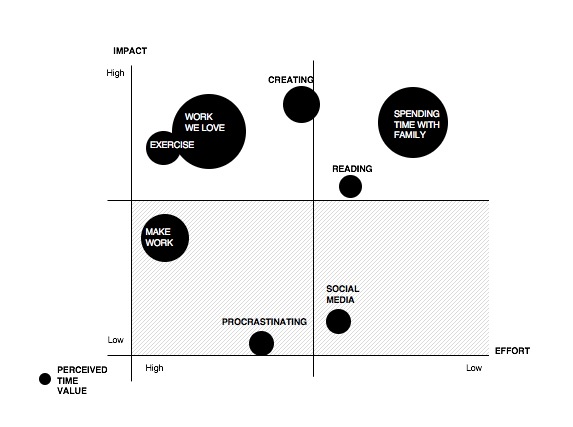
So what would we measure? Below is how I would think about return on time.

  • Impact / Outcomes:
    • Pleasure
    • Financial gain
    • Recognition
    • Building relationships
    • Improving our health
  • Effort / Energy
    • Physical
    • Financial
    • Mental
  • Time Value
    • The value we place on the time

I’d visualize it something like this:

Return on Time

It’s an interesting exercise to go through to plot how we spend our time. If we approached all of our actions with this kind of evaluation, I wonder how it would change our decisions. What would your matrix look like?

Flip the switch

I’ve been obsessed this summer with the idea of flips. A flip is the moment when the intent and context of something changes to have the opposite impact.

The idea first started with the new red dice in the game of Monopoly. They call it the speed dice which helps move what could be a many hours game along. The premise is you can roll the dice and it gives you a series of move options. If you roll Mr. Monopoly, you get to move the number spaces rolled on the other two die AND THEN move to the next available property. Once all the properties are purchased, rolling Mr. Monopoly then sends you to the first property NOT owned by you so you have to pay rent.

This rule is actually quite a startling metaphor for many things in our lives. For the entire first part of the game, you want to role Mr. Monopoly to accumulate more properties. Then, somewhere along the game, once all the properties are gone, it’s value completely changes from creation to destruction. You now need to pay on the property you land on that’s not yours.

There are so many analogous situations in life.

  • Spend your entire life saving and contributing to a retirement savings plan, but once you hit a certain age or if you have to start taking it out, you get hit with tax bills if you didn’t understand there were penalties for saving so much.
  • Start Ups are another great example. Operating models that work when they’re small, will hurt them when they grow. Changing the ways in which work is done and valued is critical.
  • ….

There are many other examples of flips. More to come on this topic.

Building and momentum

Yesterday I wrote about the behaviour behind streaks. Today, a similar topic on momentum and positive fly wheels. I’ve been working over the past 9 months on a new initiative. One which requires alignment of many many … did I say many … stakeholders. Over this time, it’s been a roller coaster of highs ( we’re getting somewhere! ) and lows ( we’re just talking in circles without direction ). In the last two weeks alone, there have been multiple cycles and loops.

This week though, something has changed. The energy has shifted and the air smells different. The initiative has carved out a foothold. The right instigations, right time, right place, right context – everyone has gotten on the train.

That’s the power of momentum when building something. You need the small wins to fuel the big wins (we’re not there yet) grounded in the grind. There is so much in the foundational set up for success. We need to align people, align problems, align intentions … and all of that alignment takes time.

I didn’t truly understand the time it takes until literally this moment. But once the ball gets rolling it gathers momentum and continues down it’s path. This is the double edged momentum sword. If it’s not going down the right hill,  the sheer energy it takes to bring it back can be crippling. Once you get it going on the right path – that’s when the magic happens. So what is your the rolling rock you will use build the next game changing product or service.

The power of streaks

Streaks are an extremely powerful motivational tool that act as a positive flywheel to achieving your goals. Streaks are typically a continued set of daily actions with a specific goal. Examples of streaks from wildly different applications:

  • Snapchat streaks – when you send direct snaps back and forth with a friend for several consecutive days
  • Pokemon Go catch streaks – when you catch Pokemon for several consecutive days
  • FitBit active days – when you reach your step / activity goal daily
  • Starbucks challenges – some challenges require purchase / try a new product for several consecutive days
  • Streaks – there’s even an app that helps you form habits!

This gamified mechanism is powerful for a number of reasons:

  • They’re habit forming. The longer you do the same thing, the more your brain and or body become familiar with the action(s).
  • Streaking is self strengthening and highly addictive – every day you successfully complete a streak, seeing the progress motivates you for tomorrow.
  • The positive momentum of streaks taps into loss aversion theory – once you are on a roll, you don’t want to stop for fear of ending your success

I personally love streaks and it’s an extremely powerful tool.
I’ve used streaks in the past to:

  • Track daily exercise / walks
  • Cut something out of my diet – caffeine and booze
  • Write daily
  • ….and many others

These were all successful while the streak was going. That said, once you miss a day, it is very easy to fall back to old habits. That’s the downfall of streaks – there is no mechanism to continue the motivation once an activity is stopped which has a rebound effect.

What do you think about streaks?

How to set your priorities

If you’re like me, the days are packed to the brim with an unending set of meetings, events, coffees and to dos that seem important but ultimately have little impact or outcome. And, if like me,  you are on the hunt for a model to help you set priorities, this is the right place:

Big Rocks, Pebbles, Sand:
Fill a jar with big rocks (the most important things you have going on),  then pebbles (the things in your life that matter, but you could live without), then sand (remaining filler – material possessions). If you start with sand in the jar, there won’t be room for rocks or  pebbles. Keep your big rocks to 4-5 at a time, manage the pebbles and try not to have too much sand.

The Urgent / Important Matrix:
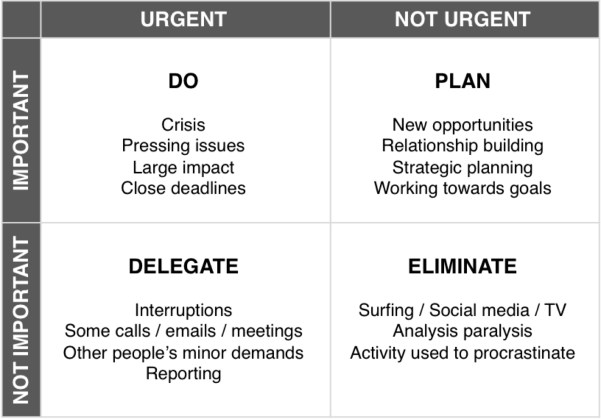
This one is fairly self explanatory. Do and Plan the important things, Delegate and Eliminate the unimportant. And do them on the appropriate timescale mapped to urgency.

Priorities Matrix

Timeline Model:
The final of the models is to look out 10 years (any longer isn’t tangible enough) and imagine what you would like to accomplish across key categories such as your health, family & friends, career, finances, spirituality, etc.  Once you have a clear understanding of those goals, bring it to the near term with near term steps that will help set you on journey. Then go back out and connect the dots from today until tomorrow. Anything that deviates from the goals and that line should not be made a priority.

These don’t need to be independent models – in fact I use them in conjunction depending on the context I’m in. Regardless of which one(s) you choose, using these frameworks will help guide how you spend your days.

Identity wrappers

This morning I had a virtual coffee meeting with a bold, “say it like it is” entrepreneur and speaker – let’s call her K – who I’m lucky to call a friend for the past 15 years. Among the things we talked about – the pendulum between insignificance and ego, an ethnography of corporate culture and the reality of just trying hold life together with tape and string.

Reflecting on our conversation – I couldn’t help but think that our approach to the world is through how we wrap our identity – what skin we’re wearing. These skins both protect us and guide our intentions and behaviour. Who am I as a corporate exec – as a leader – as a designer – as an entrepreneur – as a parent. When we surround our identity in these casings and then reflect on how we’re doing in them, it can elevate and us into ego or cast self doubt. Add to that, the fluid and rapid way in which these skins can change daily – and even hourly.

It can be both exhilarating and debilitating.
It can both define and be defined by.
You can both find and lose yourself.

Both. At the same time.

Energy ebb & flow

There is no doubt you have a million things on your plate. With the demands of work and personal life – how you manage energy will make or break you – literally. Speaking from experience (and still trying to figure it out every day), energy drives outcomes, whether desired or undesired. Managing the ebb and flow of energy in high performance, high pressure environments is incredibly difficult – but for those who have found it, all the power to them. To help manage my energy, I think about this idea:

If the house isn’t on fire, don’t worry about it
If the house is on fire and you do your job, it will go out
If the house is on fire, you do your job and it didn’t go out, it wouldn’t have anyway

Put your energy where it will matter. Avoid putting out fires that aren’t there or dwelling on fires that couldn’t be stopped after 100% effort.